Showing posts with label poetry and prose. Show all posts

Wednesday, March 21, 2007

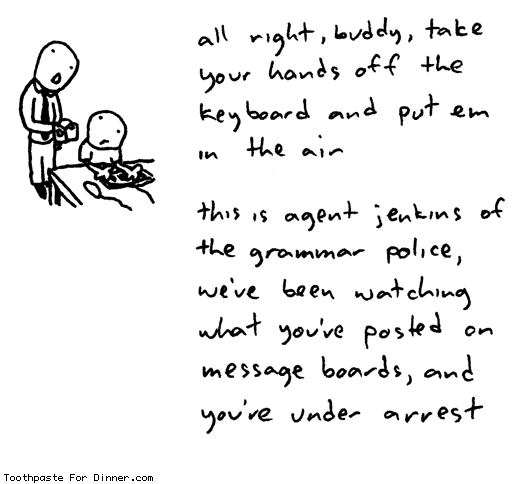
i judge you when you use poor grammar.

dear sharers of the internets,

look. i'm sorry if this appears condescending, i really am. but it's time you knew. every time you mix up "their" and "they're" a little part of me dies. it's not about the typos - we all make mistakes - but after so many times i'm starting to think you honestly don't know the difference. and if that's the case, well...this isn't going to work.

another chance? well. i suppose we could try again. as long as you get yourself into rehab. get a sponsor. and really study those 12 steps, or, at the very least, this quick & dirty primary. i know it can be embarrassing, but i just want what's best for you, after all. i'm doing this FOR you.

call me?
jadis
----------

-'s - indicates possessive (ownership).
-s - plural. use when you mean "more than one".

its vs. it's - aaah, thank you, strongbad.

similarly:
whose - possessive.
who's - "who is".

your - possessive!
you're - short for "you are".

their - possessive! possessive!!
they're - "THEY. ARE." JUST SAY IT IN YOUR HEAD WITHOUT THE APOSTROPHE, PEOPLE.


and for the love of god:

discrete - separate; distinct.
discreet - not obvious; innocuous. YOU MEAN THIS ONE WHEN YOU ARE TELLING ME ABOUT YOUR NINJA SKILLS.

principle - a rule or standard. "it's the principle of the matter."
principal - 1. the first or leading ("the principal concern..."). 2. Mr. Belding! Mr. Feeney! Principal Scudworth!

grammar - the correct spelling. note: that's TWO A's.
grammer - fraiser (kelsey grammer)'s last name.

peak - highest point.
peek - to glance quickly or furtively. like, peek-a-boo.
pique - to arouse an emotion. ANYTIME YOU USE THE PHRASE "PIQUE MY INTEREST" YOU NEED TO SPELL IT THIS WAY. I KNOW IT LOOKS WEIRD. GO WITH IT. Q's ARE RARE. GIVE THEM A CHANCE.

per se - by itself, or inherently/intrinsically true.
NOT per say - "for every say"? no!

sheek - THIS IS NOT A WORD.
sheik - islamic leader or patriarch. DOES NOT MEAN HIP OR STYLISH.
chic - hip, stylish. THIS IS THE WORD YOU MEAN. I KNOW IT LOOKS FUNNY. IT'S FRENCH. BUT TRUST ME. IT'S THIS ONE.

Monday, March 19, 2007

read this! look smart!

there were a flurry of articles last month about how to fake it...no, not like that, ladies. i'm talking about how to appear more well-read and literate than, let's face it, you really are. (pop on over to loni's blog for links to all those articles).

this one was the most unique though - a fun post by bookslut about five specific works that lit snobs might expect you know. the author's suggestion for the best way to fake that you've actually read them? cruise by on one specific scene.

all right. go on, get to it, and don't say i never did anything for you.


---------
How To Talk Like You've Read Something You Haven't

There are certain books that tend to come up in conversation over and over again. Some of the time I have read it and can hold my own. Other times, however, I’ll either say I’ve read it and then just nod and remain quiet when they try to pry a conversation out of me, or I’ll just admit I have no idea what they’re talking about.

I figured there were two remedies to the end of the conversation that comes with having not read the book. I could either read the books or I could find a way to convincingly bluff my way through the conversation.

I decided to bluff. I do have a reputation as a bookslut to uphold.

All that’s needed for a successful bluff is mentioning a scene from the book. If the book was made into a movie, don’t try to reference a scene that made it to film. Everyone does that. To make it more believable, be vague. If you don’t mention characters’ names, you can then say, “Oh, it was such a long time ago, I’m a bit hazy on the details…” when you are asked your opinion on another specific scene.

Here are some examples of books that tend to come into my conversations and scenes you can use to bluff your way through a conversation. No one will be any wiser.


Infinite Jest by David Foster Wallace

There is a wealth of material to reference in this book. The scene I tend to mention is early in the book: a character’s apartment is full of cockroaches, but he too afraid to kill them. Instead, he traps them in glasses until his apartment is an obstacle course of upside down glasses with a cockroach in each, lethargically refusing to die.

However, that scene is pretty early on in the book. If you want people to think you read at least a bit more, there’s always the rehab. A man escapes from rehab every night to put cats in bags and set them on fire. That might be harder to work into polite conversation, however.


Ulysses by James Joyce

Masturbation should always be a great cocktail party topic. And if there’s such a thing as a great masturbation scene from literature, I think James Joyce has a fine contender with his Gerty / Leopold Bloom scene.

The scene itself doesn’t consist of much. Gerty sees Bloom on a hill, and being a romantic schoolgirl, she envisions him as a heroic character. Joyce satirizes a great deal of romance novels with Gerty’s inner monologue. The kicker of the scene is that while Gerty is imagining them running away together into the sunset, Bloom is jerking off to her hemline. When she stands to walk away, he notices she walks with a limp. His reaction? “Glad I didn’t know it when she was on show.”


Fight Club by Chuck Palahniuk

The movie is very faithful to the book until the end, so the ending is what you’ll want to use. It’s best to just get indignant to how they changed the ending, because that’s the complaint I hear the most.

The buildings didn’t explode in the book because Tyler favored a more faulty type of bomb. The narrator shot himself surrounded by Marla and an assortment of the support group members.

Or you could mention that the soap in the book was made from the liposuctioned fat of Marla’s mother.


House of Leaves by Mark Z. Danielewski

The scene that creeped me out the most was always hearing the S.O.S. tapping through the strange doorway.

However, if you mention the letters from Truant’s (the narrator of the story) mother in the hospital, you can pretend like you’ve read two books, House of Leaves and The Whalestoe Letters. Truant’s mother was institutionalized and died in the hospital. One theory I’ve seen mentioned a few times is that the entire book is her delusion. Doesn’t hold up well, but can inspire passionate conversations about the book. All you have to do is bring it up, then stand back and nod.


The Invisibles by Grant Morrison

There is some controversy over whether The Matrix ripped off The Invisibles. Even Morrison seems to think it’s true. If this ever comes up, this is what Kenan thinks you should say:

“What a load of bullshit. If Morrison wants to be angry at someone for ripping him off, he should be mad at Osama bin Laden for stealing his idea for decentralized cells of terrorists. Jesus.”

-------
find the article here if you'd like. how about that liposuctioned fat, eh?

Saturday, December 16, 2006

bookworms vs. nerds - article/blog


what do you think, kids, does this explain me? a recent study by the british psychological society found that the "more fiction a person reads, the more empathy they have and the better they perform on tests of social understanding and awareness. By contrast, reading more non-fiction, fact-based books shows the opposite association."

Monday, December 11, 2006

"this american life" tries a new medium - article


so i'm a television fanatic, but there is something timeless about stories told and heard over the radio as well.

"this american life" is my favorite program on npr - it feeds into my addiction to good storytelling, and probably was the reason i first began to appreciate non-fiction. (some choice selections for the uninitiated all from the staff favorites page, or you can just go to the site and search for anything and everything david sedaris has ever done.)

and now, it looks as though the npr staple is crossing over.

--------

'This American Life' Is Ready for Its TV Close-Up
by Lynn Neary
All Things Considered, December 5, 2006

OK. Rats. They could film rats running in circles. It would be creepy. It would be cool.

No, scratch that. Humans in rat suits!

That's just one of the many odd discussions that took place in the process of transforming a radio program into a television series. The show is This American Life. The host is Ira Glass. The TV series will debut in March on the Showtime cable channel.

There's a certain simplicity to the art of radio. At its heart, it's all about storytelling. And This American Life is a radio show that revels in storytelling -- quirky stories, sad stories, scary stories.

This American Life seems so wedded to the medium of radio that when the Showtime cable network first approached Glass about turning it into a TV show, he couldn't imagine it.

"We basically said 'no' for a year and half," Glass recalls. "And we kept saying we have no idea how to... be filmmakers. You have to hook us up with people who could design something that got across the feeling of the radio show."

They found those experts in cinematographer Adam Beckman and director Chris Wilcha. Sometimes Beckman and Wilcha have to tell people steeped in radio that their ideas just won't work on television. Other times, they take the ideas and turn them into compelling visual images.

Like the rats. This story, dealing with erasing memory in rats, caught the staff's attention when they heard that real people had called the researchers because they wanted their own bad memories erased. But Wilcha was struggling with the visuals. While Beckman and his crew worked, Wilcha pulled Glass aside to pitch his ideas, which included humans in rat suits.

It's not the first time Glass has been a bit taken aback by one of Wilcha's ideas. Take the desk, for example. They'd been trying to figure out Glass's role as host. Would he just be an off-camera voice? And if not, would he do stand-ups on location or would he appear on a set?

In the end, they decided to give him a desk. But not just any desk.

"What if your desk appeared out on the landscape?" Wilcha wondered. "On an abandoned freeway, on the Salt Flats, in the woods. But you never make mention of it or point to it."

So Glass, staring at the audience through his big, black-framed glasses, introduces the show and the stories from behind a sleek, art deco desk made of shiny, red wood. In one shot, the desk and Ira sit in the middle of Utah's Salt Flats, looking like an inconsequential speck in a vast moonscape.

Perhaps the most painful adjustment for Glass was having to perform for the camera. Not only did he have to say his lines over and over again -- on camera, in a very public setting, surrounded by a huge crew -- he also had to watch himself over and over again.

"I don't see any positive aspect of being on camera," Glass says. "I am 47 years old, I don't like looking at myself. After a certain point, no one likes looking at themselves on television. There's just no up side."

But for all the complications of television, producer Nancy Updike says there have been moments of unexpected pleasure. A longtime radio producer, Updike wasn't sure This American Life would translate to a visual medium. Then she saw the pilot.

In a story about efforts to bring a bull named Chance back from the dead, Updike was surprised that they had managed to transfer the feel of the radio show to television. And the images of the bull provided a pleasure that radio could not.

"They're almost glamour shots of the bull, different parts of him, and he's in shadow and it's breathtaking," Updike says. "It's a moment you can't have in a radio show, a moment of pure visual reverie."

And that's no bull.

-------------
found here, and you can listen to it here.

Saturday, October 07, 2006

i want to feel this way again

from post secret


-------Email Message-------
Sent: Saturday, September 30, 2006 8:30 PM

My boyfriend and I knew we had to do something important or else our relationship would fall apart. So we took markers and wrote our deepest secrets on the backs of each other.

I never read his secrets, and he never read mine, but the perilousness of such close contact between us and the other's demons was what we needed to save our relationship.


doesn't that sound beautiful?

Tuesday, September 19, 2006

better put a patent on it

(by tom stoppard)

AEH. If only an army should be made up of lovers and their loves! - that's not me, that's Plato...'although a mere handful, they would overcome the world, for each would rather die a thousand deaths than be seen by his beloved to abandon his post or throw away his arms, the veriest coward would be inspired by love.' ...But there was such an army, a hundred and fifty pairs of lovers...At the end of that day, says Plutarch, the victorious Philip of Macedon went forth to view the slain, and when he came to that place where the three hundred fought and lay dead together, he wondered, and understanding that it was the band of lovers, he shed tears and said, whoever suspects baseness in anything these men did, let him perish.

HOUSMAN. I would be such a friend to someone.

AEH. To dream of taking the sword in the breast, the bullet in the brain -

HOUSMAN. I would.

AEH. - and wake up to find the world goes wretchedly on and you will die of age and not of pain....Lay down your life like a pack on the roadside though your days of march are numbered and end with the grave. Love will not be deflected from its micheif by being called comradeship or anything else.

HOUSMAN. I don't know what love is.

AEH. Oh, but you do. In the Dark Ages, in Macedonia, in the last guttering light from classical antiquity, a man copied out bits from old books for his young son, whose name was Septimius; so we have one sentence from "The Loves of Achilles." Love, said Sophocles, is like the ice held in the hand by children. A piece of ice held fast in the fist. I would I could help you, but it's not in my gift.

HOUSMAN. Love it is, then, and I will make the best of it.


(from the invention of love)

Monday, May 08, 2006

so we'll go no more a-roving

so, we'll go no more a-roving
so late into the night,
though the heart be still as loving,
and the moon be still as bright.


for the sword outwears its sheath,
and the soul wears out the breast,
and the heart must pause to breathe,
and love itself must rest.


though the night was made for loving,
and the day returns too soon,
yet we'll go no more a-roving
by the light of the moon.


[thanks, lord b.]

Wednesday, February 08, 2006

your studies of fringe new york streets...

last night i dreamt that i was you. i was dressed all in black with dark glasses and attitude.
such a pose i could simply not hold through days in a northern town that i had once called a home.
your studies of fringe new york streets... i was reading the pavement in every work you would speak.
to a "brownstone up three flights of stairs" and it's on...
buying drinks for the poets upstate, this southern corruption towed you down the interstate,
and they all said that you were the king of gloomy disruption that surfaced when you would speak.
this town simply cannot compete so i'm packing my bullets and silverstones
and heading east to a "brownstone up three flights of stairs" and it's on...
if i could have had my way this year would bridge '66 again
trust fund hipsters were casing the room chock full of amphetamines.
the overturned kick drum book set the pace with incomparable cool.
and if the tempo was lousy it was lost on all but you...

(death cab)

Wednesday, September 07, 2005

i love mcsweeney's - 2

Things My Brother Has That I Don't.
BY SCOTT EVAN NEWCOMB

- - - -

A driver's license
My parents' love
A doctorate
A sense of pride and dignity
Checking account
Ballerina as a girlfriend
Respect
Herpes


i am *such* a nerd!! i love this:

Klingon Fairy Tales.
BY MIKE RICHARDSON-BRYAN

- - - -

"Goldilocks Dies With Honor at the Hands of the Three Bears"

"Snow White and the Six Dwarves She Killed With Her Bare Hands and the Seventh Dwarf She Let Get Away as a Warning to Others"

"There Was an Old Woman Who Lived in a Shoe With a Big Spike on It"

"The Three Little Pigs Build an Improvised Explosive Device and Deal With That Damned Wolf Once and for All"

"Jack and the Giant Settle Their Differences With Flaming Knives"

"Old Mother Hubbard, Lacking the Means to Support Herself With Honor, Sets Her Disruptor on Self-Destruct and Waits for the Inevitable"

"Mary Had a Little Lamb. It Was Delicious"

"Little Red Riding Hood Strays Into the Neutral Zone and Is Never Heard From Again, Although There Are Rumors ... Awful, Awful Rumors"

"Hansel and Gretel Offend Vlad the Impaler"

"The Hare Foolishly Lowers His Guard and Is Devastated by the Tortoise, Whose Prowess in Battle Attracts Many Desirable Mates"

Sunday, August 28, 2005

things breaking


y aquel relojand the clockface
cuyo sonidowhose cadences
erauttered
la voz de nuestras vidas,our lifetimes,
el secretothe serective
hilothread
de las semanasof the weeks,
que una a unaone after another,
ataba tantas horasyoking the hours
a la miel, al silencio,to the honey and quietude,
a tantos nacimientos y trabajos,the travails and births without end -
aquel reloj tambiéneven the clock
cayó y vibraronplunges downward, the delicate blues
entre los vidrios rotosof its viscera
sus delicadas vísceras azules,pulse in the splintering glass
su largo corazónand its great heart
desenrollado.springs open.


from pablo neruda's " oda a las cosas rotas (ode to things breaking)"

Tuesday, August 23, 2005

criminal law blurb.

Though law and morality are not the same,

and many things may be immoral which are not necessarily illegal,

yet the absolute divorce of law from morality would be of fatal consequence;

and such divorce would follow if the temptation to murder in this case

were to be held by law an absolute defence of it.


*sigh* so there is some hope...and poetry in this after all.

Tuesday, May 31, 2005

"i smoked crack & wrote an article about it" - article

this is an article back from 1989 that was referenced in a recent slate article (about addiction to...number puzzles!), but i've thought so much about journalism and its repercussions today it seemed like a good post/article to share (i've been reading slate's old deep throat theory articles, that's why). it's fascinating when there's such cultural and media backlash--or maybe just sheer *reaction*--following a story - at what point are journalists making the news as opposed to just reporting it?


Cross fire in the drug war: aftermath of a crack article.

BY: Morley, Jefferson

I smoked crack and wrote an article abut it for The New Republic. As I had hoped, "What Crack Is Like" instigated many debates within the Washington political class and attracted more than a little interest outside that cloistered group. The article made three points, all of which will strike some people as self-evident: Crack is a pleasurable drug with unpleasant side effects; crack can "make sick sense to demoralized people" and the spread of crack capitalism is related to the phenomenon of Reaganism. That same week I published a historical-economic analysis of the drug problem in The Nation ("Contradictions of Cocaine Capitalism," October 2), which initially drew little media attention, no doubt because it was a more substantive article. In fact, the reactions to the New Republic piece were more interesting than the piece itself. The peculiarities of our so-called drug war and the desire for a new debate about the problem have never been more evident.

By noon of the day The New Republic rolled off the presses William Bennett had described my piece as "garbage" and called me "a defector in the drug war." In this compliment I resented only Bennett's implication that I was a soldier, not a citizen, and somehow bound to salute his efforts. Over the weekend, the usual suspects from the Sunday morning talk shows -- Pat Buchanan, Robert Novak, Al Hunt -- reiterated Bennett's criticisms, often word for word: "garbage," "irresponsible" and so on.

What especially galled the pundits was my remark that "if all you have in life is bad choices, crack may not be the most unpleasant of them." No one said this statement was untrue, as Michael Kinsley, editor of The New Republic, pointed out in my defense -- only that it was "unhelpful." Indeed, R. Emmett Tyrrell Jr., editor of The American Spectator, expressed a journalistic philosophy no longer current, even at Pravda. Tyrrell said my article was "contemptible" because I did not express support for benevolent state efforts to wipe out market activity.

Stephen Rosenfeld, a foreign policy columnist for The Washington Post, at least tried to debate the issue, devoting a confused column to my article. The ink not spent on abusing my person was spent quoting a Washington public health official about the crack experience. Rosenfeld was so excited that he never noticed the official's description of the crack experience in no way contradicted my own. The damaging effects of addiction to drug war rhetoric were evident. Rosenfeld asserted that crack "withers the mothering instinct" among the female users. Exactly how the drug does this, biologically and chemically, he was unable to explain.

The following Monday morning, I went on C-Span, the public affairs cable channel, and exchanged pleasantries with Brian Lamb, a conservative gentleman and a soothing interlocutor. Wasn't I condoning the use of crack? Lamb inquired. If anything I was discouraging it, I said. The curious could learn about the drug from my article. If they took it seriously, they would learn that in one man's very limited experience, crack's pleasure quickly gave way to its side effects, combining "the worst of marijuana and cocaine" and inducing both stupefaction and paranoia. "Let's go to the phones," Lamb said, eyes twinkling. He was enjoying the prospect of my imminent pasting by the vox populi.

Thirteen of the next fifteen callers approved of my article, several of them using the same phrase, "I'm with you 100 percent." What came through most consistently in the comments was a sense of relief at hearing someone in the media say something--anything--outside the rhetorical consensus of just-say-no and zero-tolerance.

I went on radio talk shows in Washington, Milwaukee, Detroit and Boston. "What's crack like?" my interviewers inevitably wanted to know. Or did they? Crack has been around for six years and smoked by millions of Americans. I asked several of these media representatives if they had ever posed the question to the many available crack users in their home towns. Most had not. They were such loyal soldiers in the drug war that they had forgotten to do their jobs. Others said that they regarded local crack smokers as less reliable and less interesting than me. "You're a real person," one TV reporters said in a revealing slip. "I mean, you're a real, articulate person."

The inevitable second question was, "They say you smoke crack once and you're addicted. Are you addicted?" The answer was no. I often replied by asking why they believed that one-time crack use leads to addiction. "That's what everybody says," answered Mark Belling, a talk show host in Milwaukee. Had he ever conducted a survey of crack users in his city to answer the question for himself? Neither he nor any other journalist critical of my article had ever attempted such reporting. (In fact, Harper's magazine reported in November that six out of ten crack users eventually become addicted, compared with nine out of ten cigarette users.)

...

blogger's note: i could have sworn i got this from a public source. but...perhaps i didn't. sorry. the remaining part of the post has been removed.